Yes — you can sleep at Don Mueang Airport overnight. The airport stays open 24 hours.
Many travelers rest on benches while waiting for early morning flights.
The quietest areas are usually:
- Terminal 1 arrivals level benches
- Connector corridor between terminals
- Observation Deck area on the 4th floor
However, the biggest risk is missing check-in deadlines for early flights, especially with low-cost carriers.
This guide explains where to sleep, how quiet the airport gets at night, and what to expect if you stay overnight.
If you have a very early flight or need to spend a night after arrival, this guide should help you decide whether Don Mueang is a workable airport for an overnight stay.
- Can you stay overnight at Don Mueang Airport?
- What Don Mueang feels like at night
- Overnight timeline: what changes between 11 PM and early morning
- Terminal 2 (Domestic) is better if you want a quieter night
- Terminal 1 (International) changes a lot by the hour
- Quietest hidden spot: the Observation Deck
- The terminal connector is one of the classic overnight areas
- Food and convenience stores overnight
- Wi-Fi and charging: good enough overnight
- Is it safe? What about solo female travelers?
- Paid option: Sleep Box by Miracle
- Left luggage services exist, but are not essential
- Lounges and waiting airside
- Biggest danger of airport sleeping: missing check-in
- Best place to sleep at Don Mueang Airport
- Who should and should not sleep at Don Mueang?
- Final verdict: yes, Don Mueang airport sleeping works
Can you stay overnight at Don Mueang Airport?
People do sleep on the benches here.
Don Mueang Airport operates 24 hours a day. There is no full shutdown overnight, and there are always at least some arriving passengers, departing travelers, or people waiting for early flights.
I checked the airport from around 11 PM through early morning. The terminal lighting stayed bright, and the airport never felt dark or half-closed. Traffic levels changed by the hour, but it never turned into an empty space.
At Terminal 1 (International), flights continue late into the night, so the check-in area remains active from around 11 PM to 1 AM.
At Terminal 2 (Domestic), traffic drops much earlier, and the departure floor becomes noticeably quieter.
For overnight stays, you can remain in the landside public area before security. That means both late arrivals and early departures can stay in the same general part of the airport without any issue. If your airline allows early check-in, moving airside later is another option, but the public area was already usable enough.
So if you are worried about being kicked out late at night, that is not the issue here.
Don Mueang does allow overnight stays in practical terms.
If you want a full breakdown of terminal layout, floors, and access, that belongs in the complete Don Mueang airport guide.
What Don Mueang feels like at night
My honest impression was simple: quieter than expected.
Around 11 PM, the international side still has movement. The check-in counters can be busy, especially when several low-cost carrier flights overlap. But after 1 AM, that wave starts to fade, and by around 2 AM the airport becomes much calmer.
It never turns empty, but the rush disappears.
Noise level
At night, the airport is not silent, but it is not especially noisy either.
What I noticed:
- Fewer announcements than during the day
- No constant loud paging
- Occasional cleaning machine noise
- Robot cleaners moving around regularly
It is not library-quiet, but it is calm enough that people do lie down and rest.
Brightness
The lights stay on at normal airport brightness.
That is good for safety, but not ideal if you need darkness to sleep.
If you are sensitive to light, an eye mask helps.
Number of people
There are always some travelers around, including:
- people lying on benches
- people resting with suitcases as pillows
- people charging phones and waiting out the night
Solo female travelers were not unusual. The airport still felt lived-in, not abandoned.
So overall, Don Mueang at night feels quiet, but not empty.
That kind of atmosphere is exactly what makes airport sleeping workable.
If you are heading into the city the next morning, Grab and the Red Line are the standard options. If you want a full breakdown of the available routes, see the Don Mueang Airport to Bangkok city transport guide.
Overnight timeline: what changes between 11 PM and early morning
Around 11 PM
The international departure area is still busy. Low-cost carrier check-in lines are common.
Around 1 AM
The check-in wave starts to slow down. Movement becomes lighter.
Around 2 AM
This is the calmest part of the night. If you want to rest, this is the best window.
Around 3:30 AM onward
Passengers for early morning flights start appearing again, and the airport begins waking up.
After 5 AM
The airport returns to near full operating mode.
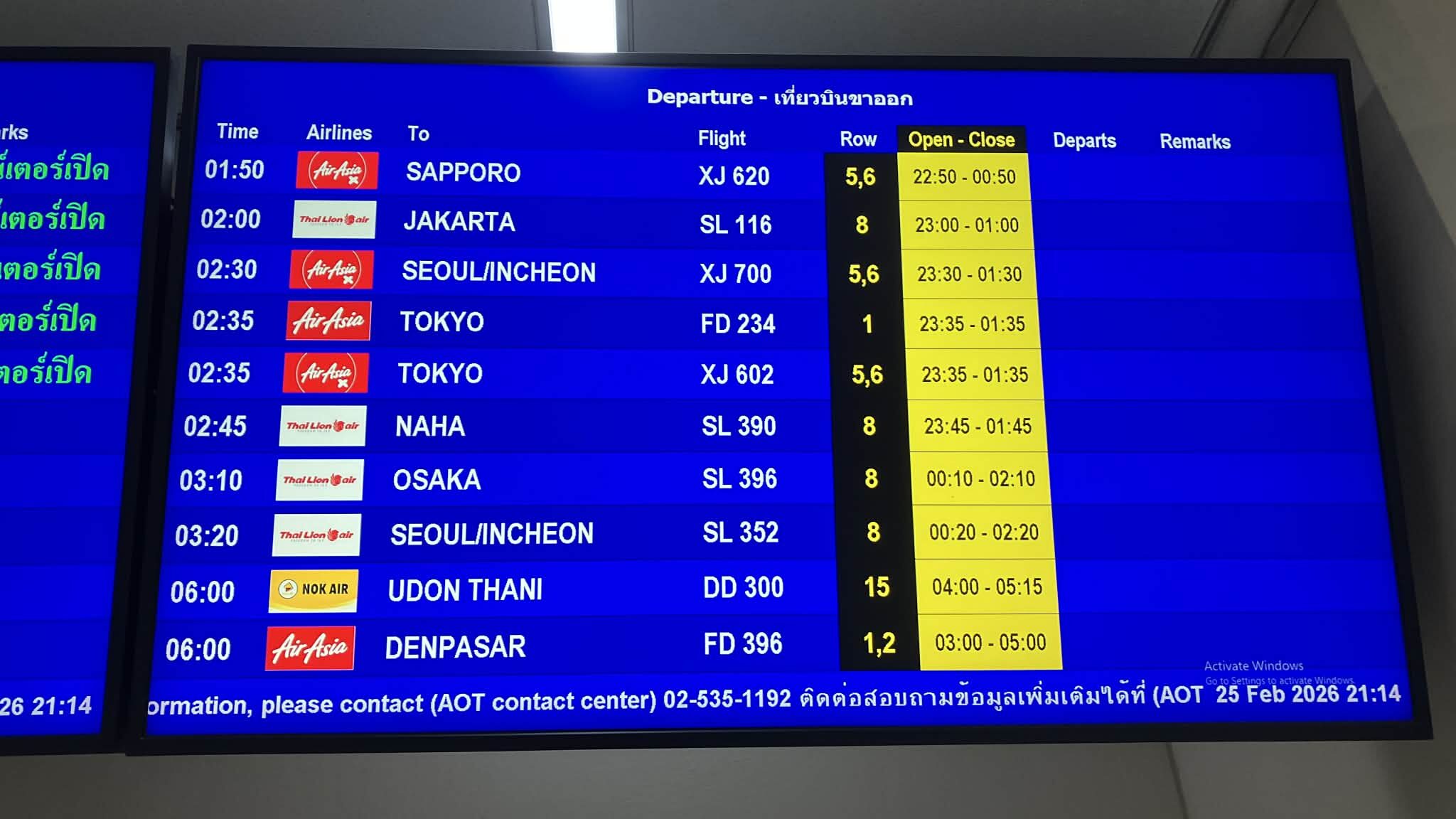
This pattern makes sense once you look at the flight schedule. Don Mueang has a cluster of late-night and early-morning low-cost carrier departures, including flights operated by AirAsia and Thai Lion Air.
Because of this schedule, the airport is not quiet all night long. It becomes calmer only after the late-night check-in wave ends, then gradually gets busy again before dawn.
Terminal 2 (Domestic) is better if you want a quieter night
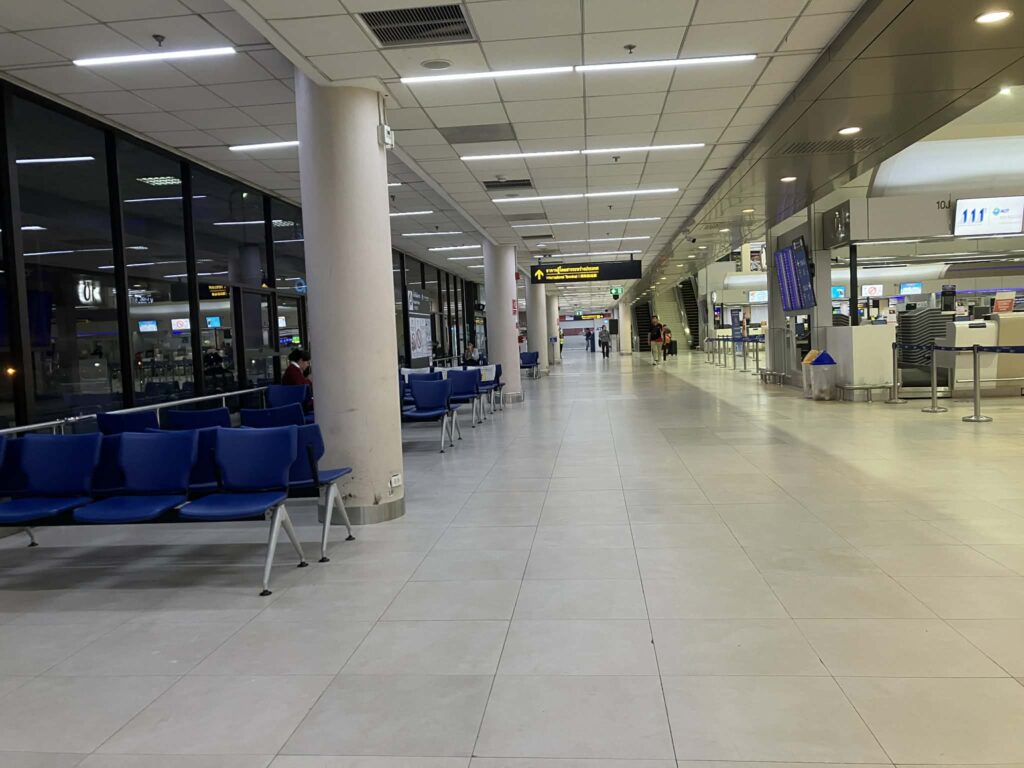
If your priority is simply finding a calmer place to rest, Terminal 2 is the stronger option.
Passenger traffic on the domestic side drops quite early. By around 9 PM, the flow is already lighter, and late at night the 3rd floor departure area becomes very quiet. Around the check-in counters, activity mostly stops. The space feels large and almost empty, with only scattered travelers remaining.
The 1st floor arrivals area is also quiet. It never becomes completely empty, but compared with the international side, the difference is obvious. There are few announcements, and the main sounds are occasional cleaning machines.
For a few hours of rest, it works well.
Bench situation
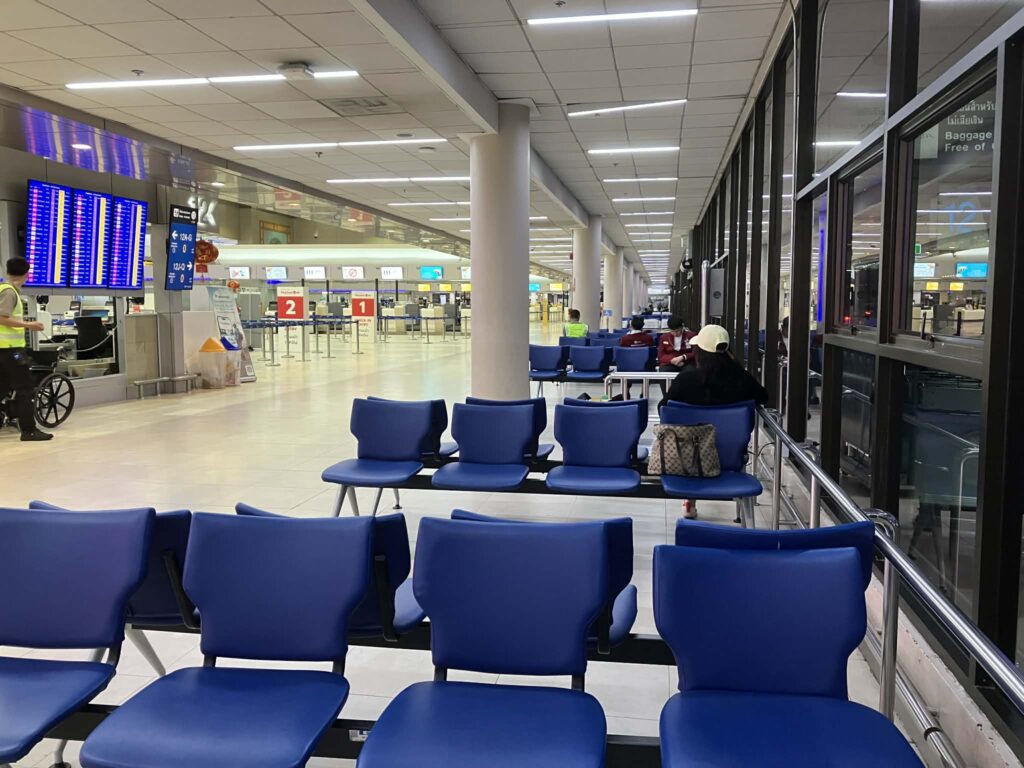
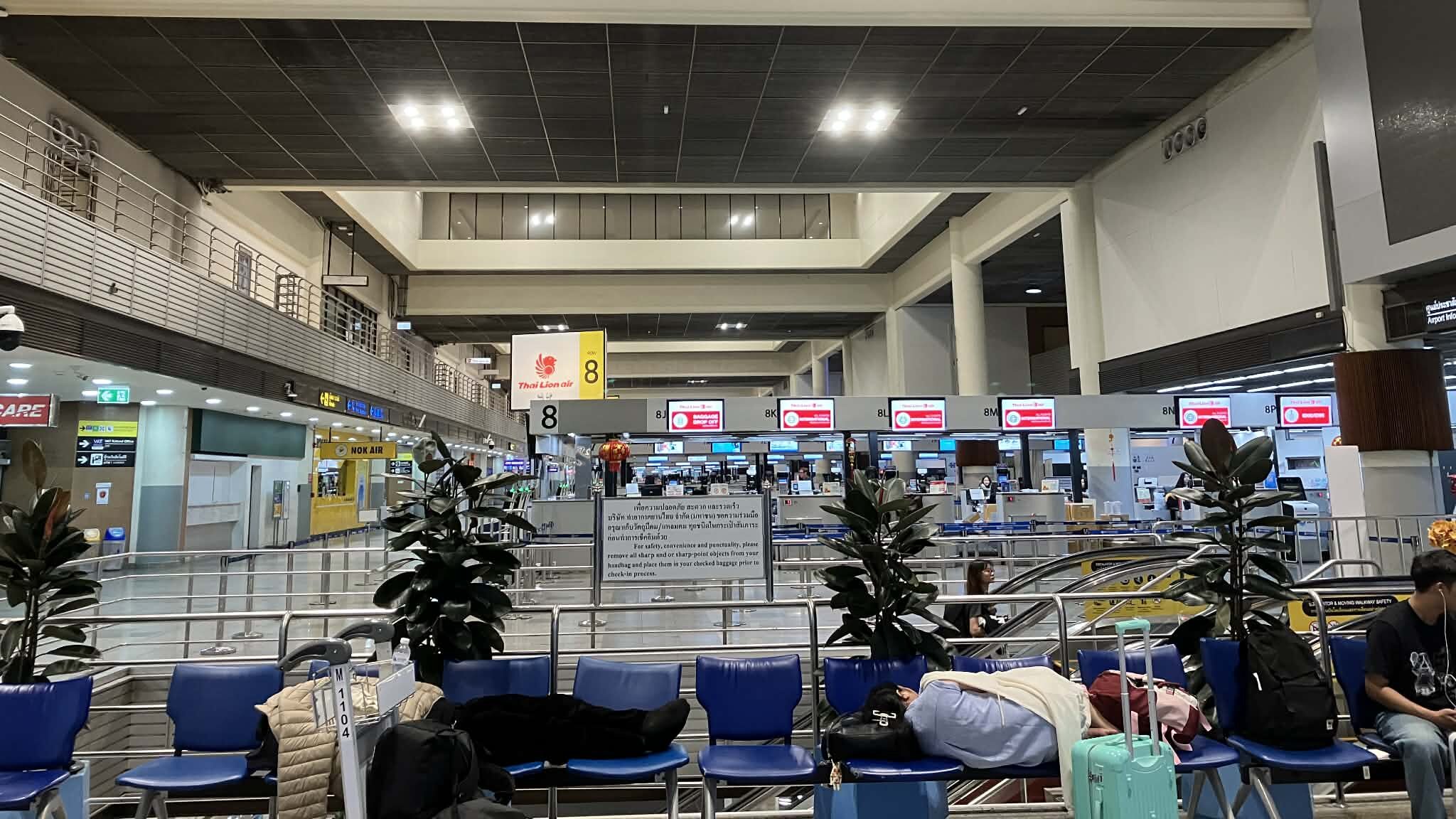
Most benches in Don Mueang’s public area do not have armrests in the middle.
That matters, because it means people really can stretch out.
Late at night, it is common to see people lying flat on benches with luggage beside them. Sleeping on the floor happens, but it is not the main pattern. Bench sleeping is far more common.
Air conditioning
The airport felt a bit cold overnight.
If you are staying for several hours, bring at least a light jacket. Some travelers also had blankets.
Terminal 1 (International) changes a lot by the hour
The international terminal follows a different rhythm.
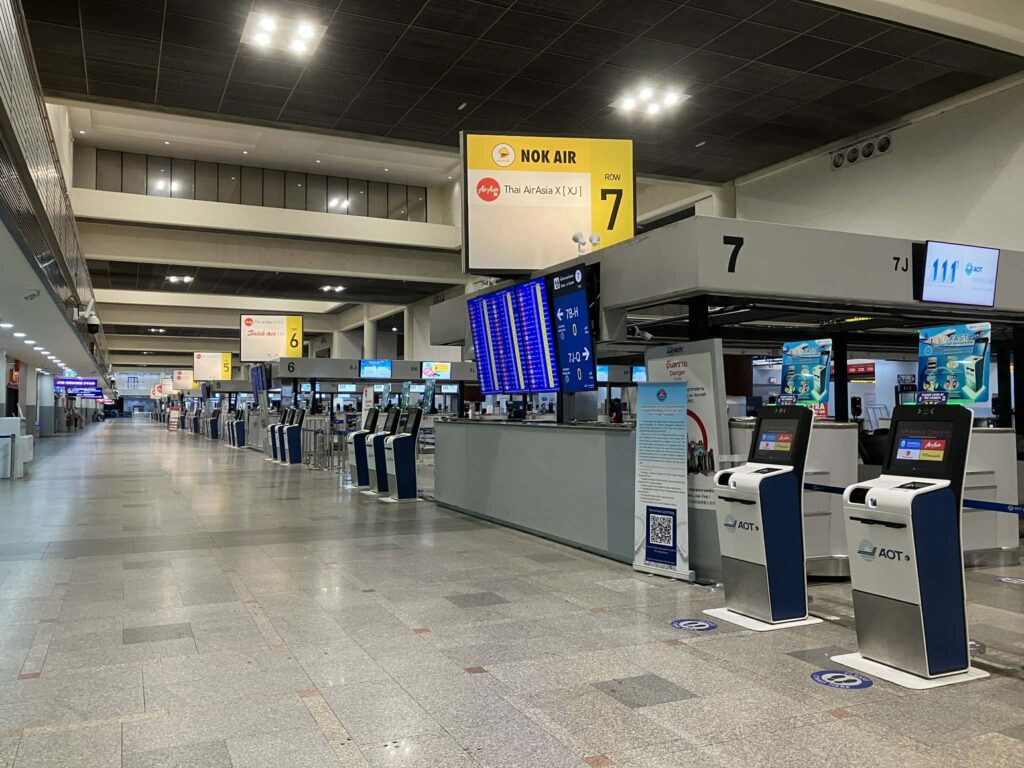
Around 11 PM, it is still active. Several flights overlap, and the check-in area feels like a normal late-night airport rather than a place for sleeping.
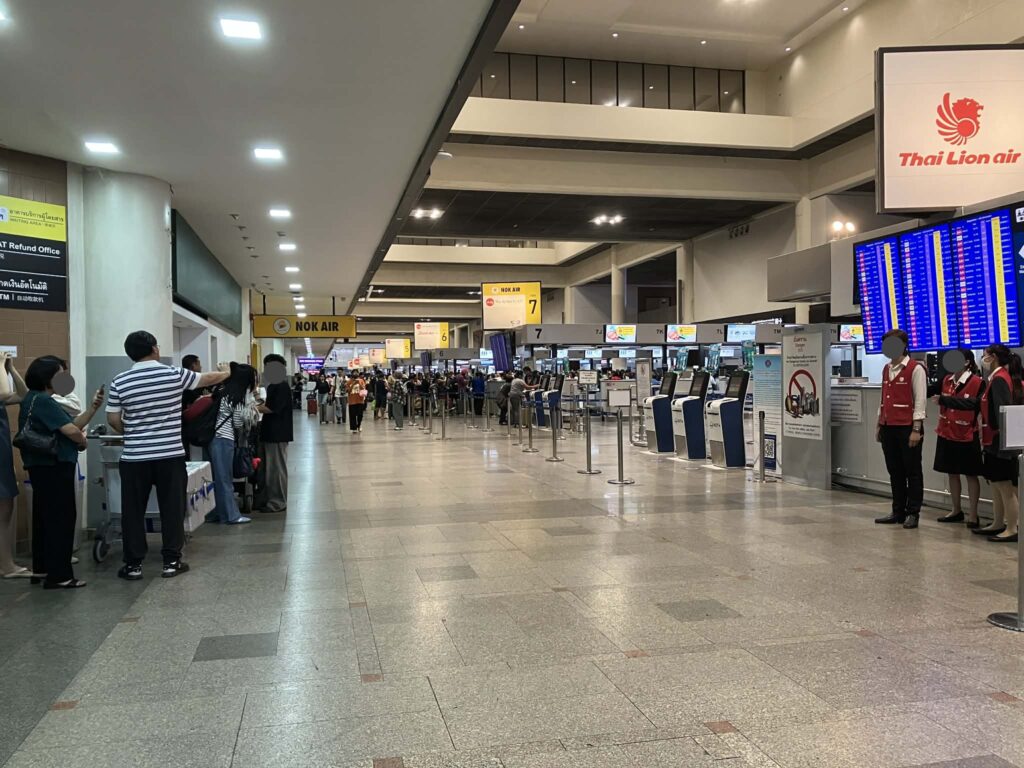
Then the mood changes.
After 1 AM, movement slows, and by around 2 AM the check-in rush is mostly over. That is when the space starts feeling calmer.
Bench areas
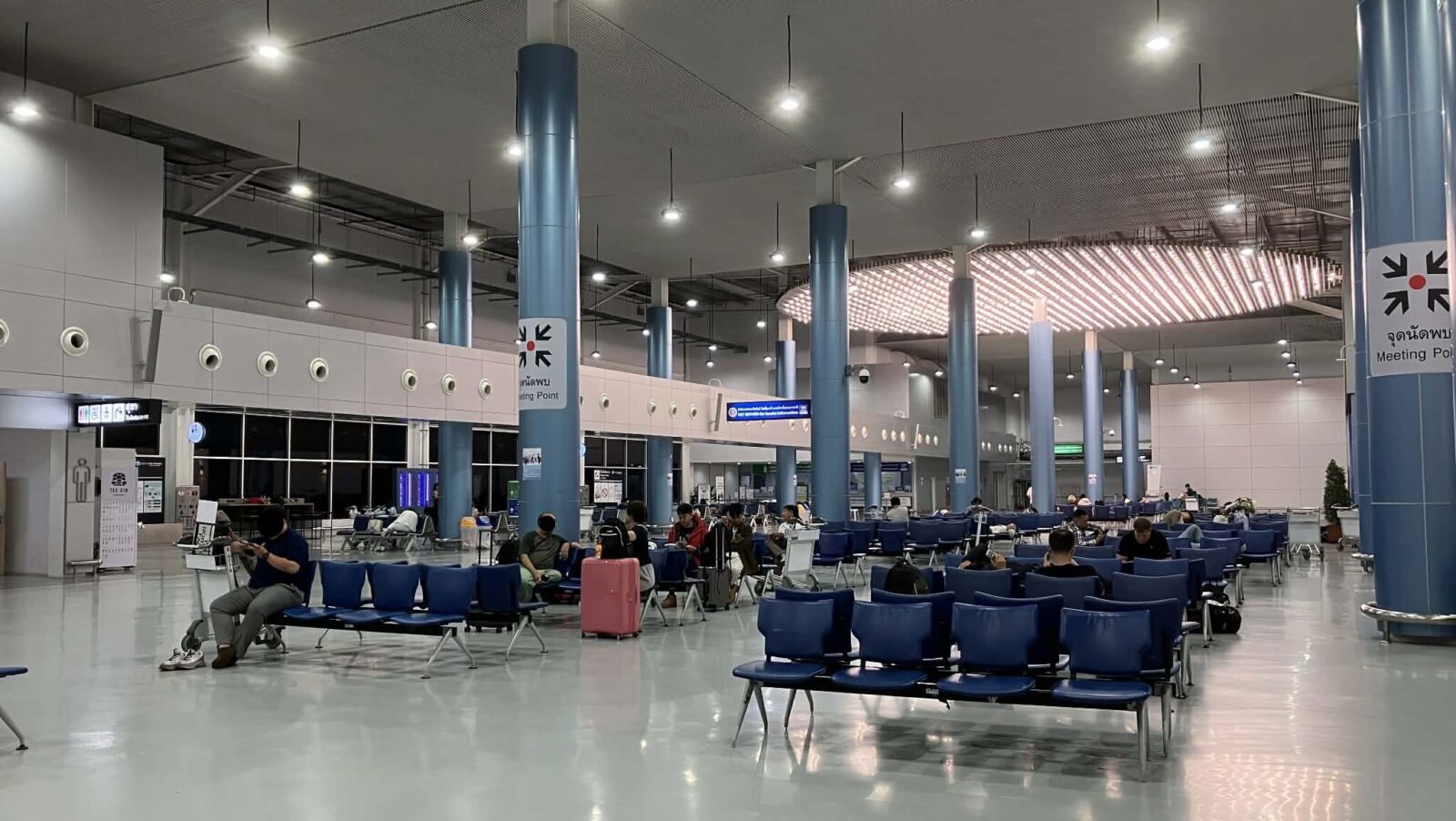
On the 3rd floor and 1st floor of Terminal 1, there are bench areas where many travelers wait for early flights.
Even late at night, there are usually plenty of people around, but also enough benches that finding a place to sit is rarely difficult. People lying down are common.
Meeting point area
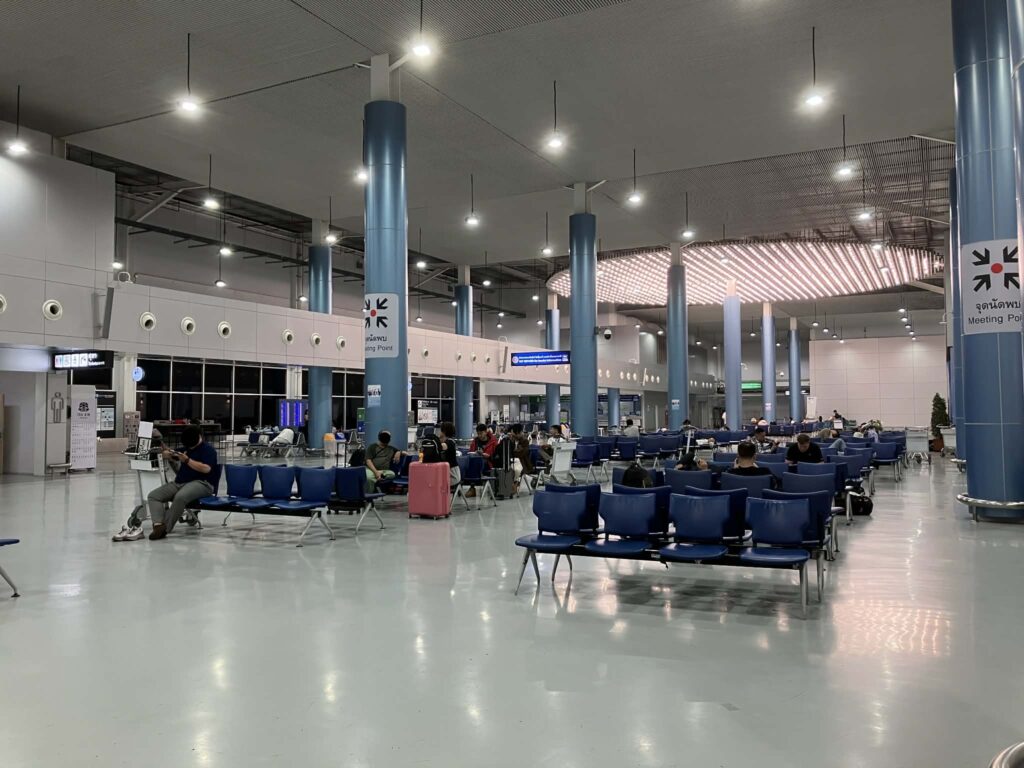
One recurring overnight zone is around the meeting point near the edge of the terminal.
There are groups of benches there, and it attracts travelers who are clearly in overnight mode. It is not silent, but it is usable for resting.
Quietest hidden spot: the Observation Deck
On the 4th floor of Terminal 1, there is an Observation Deck area.
You can access it near McDonald’s, and it is open 24 hours.
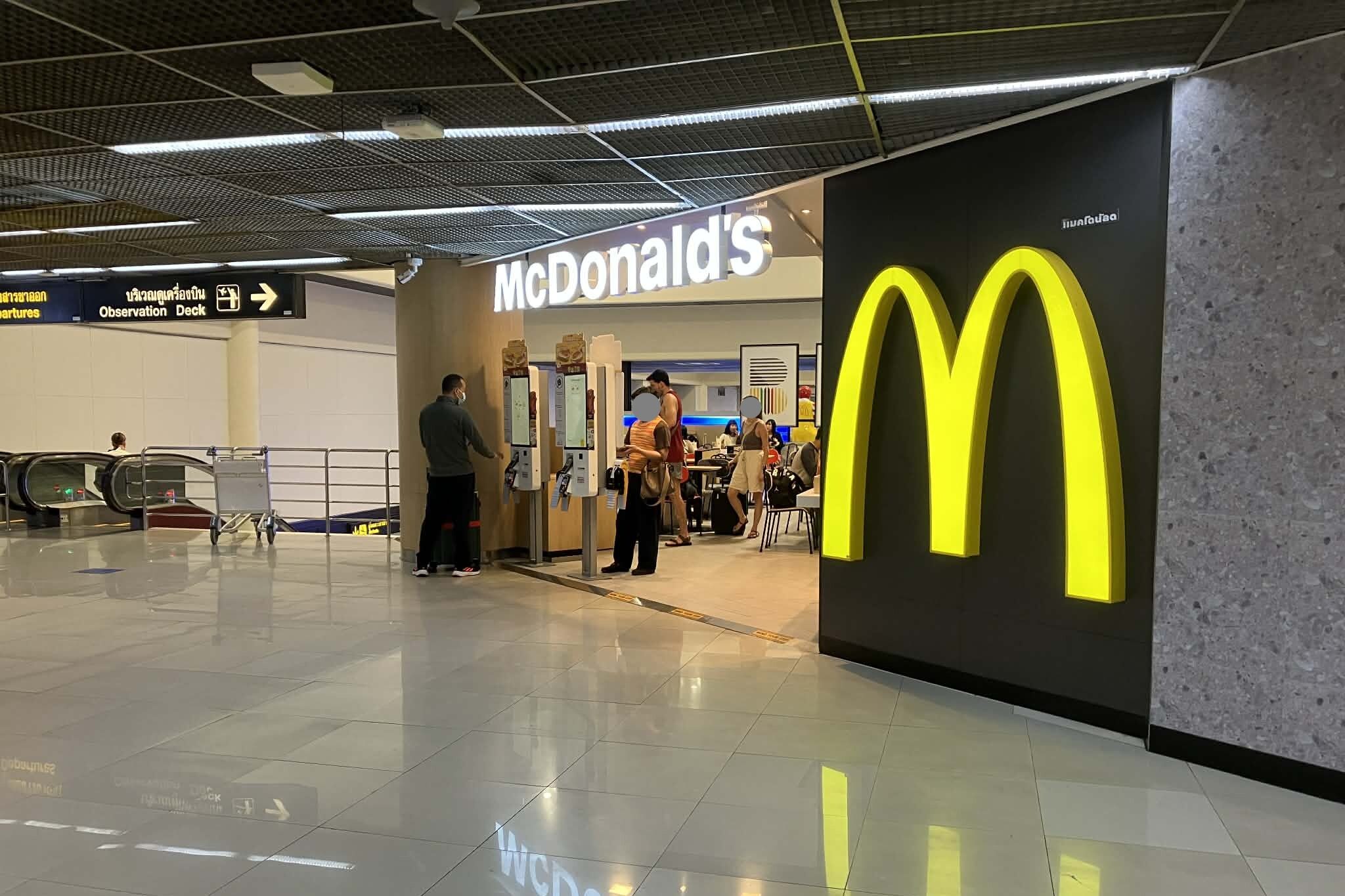
This was one of the more interesting places in the airport.
Compared with the main departure floor, the atmosphere is clearly calmer. There are fewer people, much less foot traffic, and fewer interruptions. It is not empty, but it feels more removed from the main flow of the airport.
The lighting is still on, but slightly softer than the main areas. That makes it easier to rest.
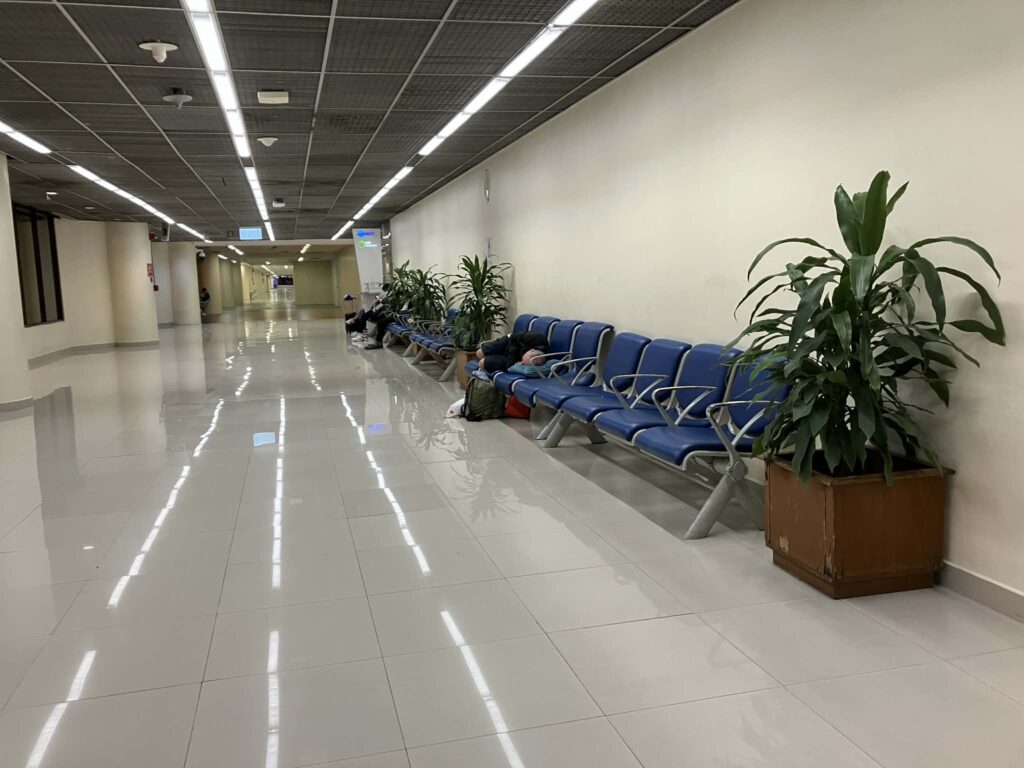
There are no beds, but there are benches you can lie down on.
There are not many of them, but the area itself is spacious, and late at night it can work well for quiet rest. I did see travelers stretched out there.
It is also one of the few places in Don Mueang where you feel less surrounded by constant movement. If your main goal is to reduce noise and passing traffic, this is a strong option.
During the day, the observation deck is for runway views.
At night, of course, it is just darkness outside. This is not about the view. It is about the atmosphere.
The terminal connector is one of the classic overnight areas
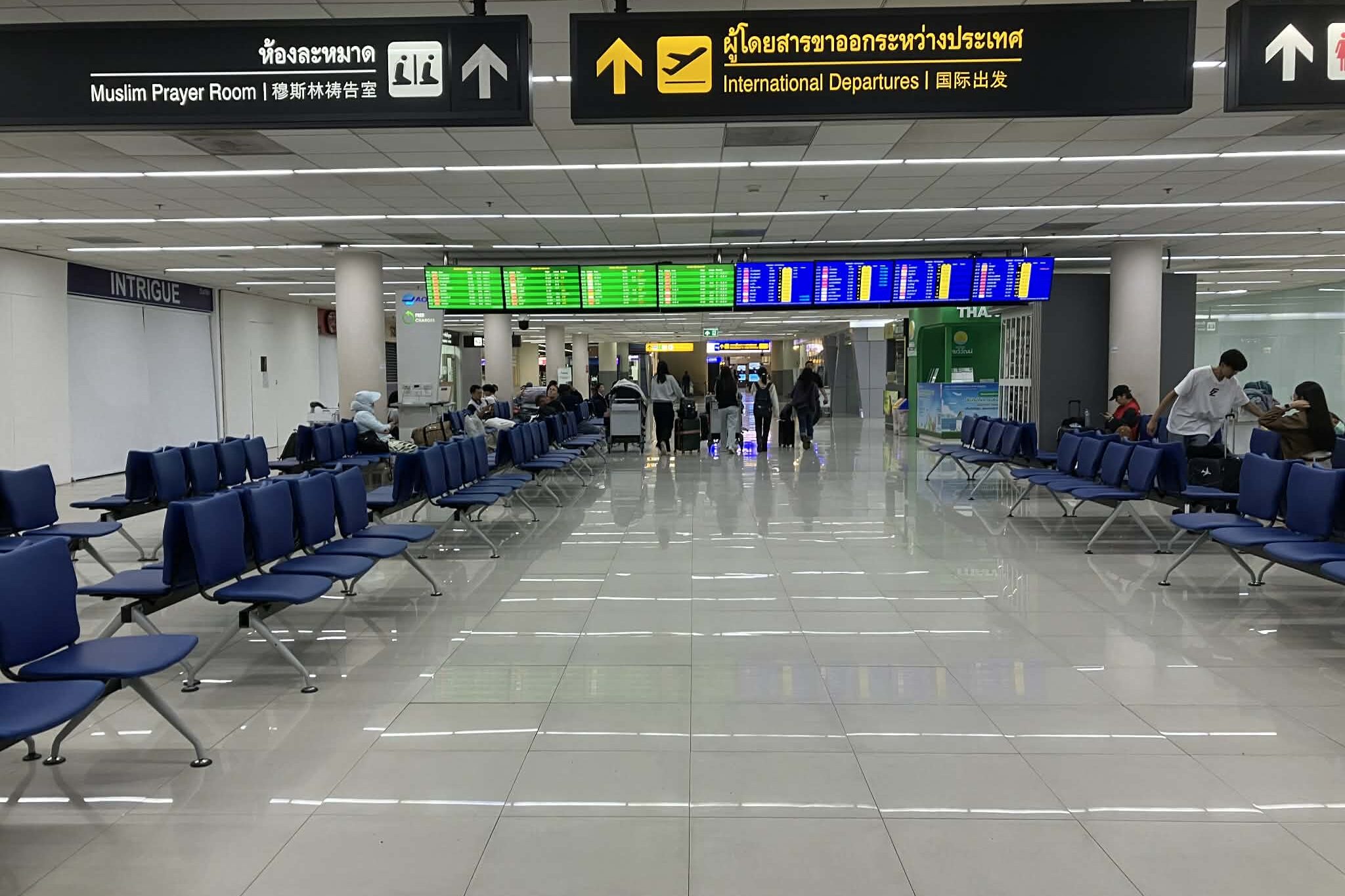
There is also a bench-heavy corridor connecting Terminal 1 and Terminal 2.
Late at night, this felt like one of the airport’s standard sleeping zones. You see travelers lying down, resting beside their luggage, or charging phones while waiting for morning departures.
There are still people around, but it does not feel hectic. The number of passers-by is limited, and the bench supply is decent. It is not perfectly quiet, because it is still a corridor, but it works as a practical middle-ground spot.
If you want a realistic answer rather than an ideal one, this is one of the most typical places where airport sleeping actually happens.
Food and convenience stores overnight
For an overnight stay, food and drinks matter.
The good news is that Don Mueang is easy enough for overnight supplies.
Convenience stores
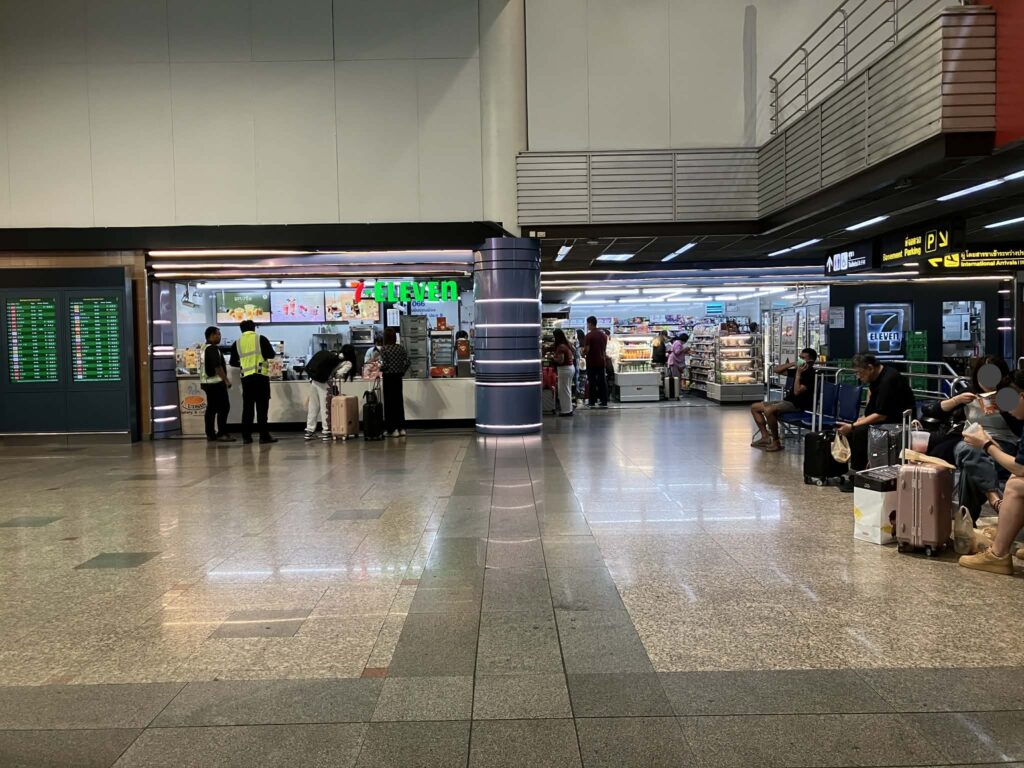
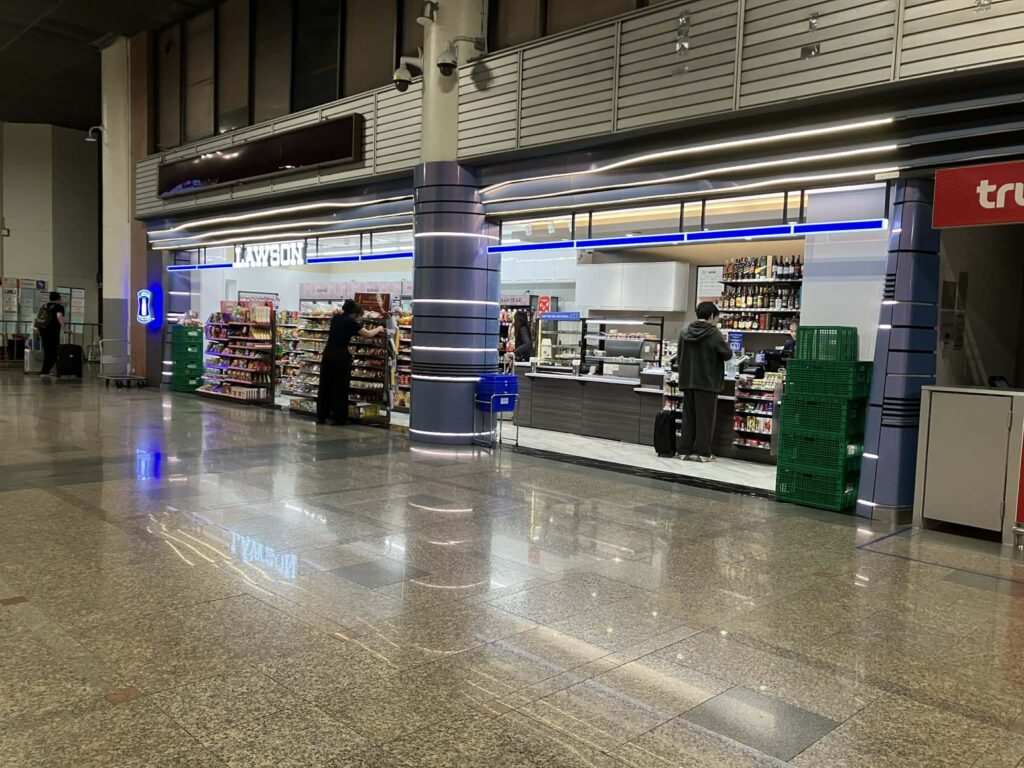
There are:
- 3 Seven Elevens
- 2 Lawsons
These are open 24 hours.
That means drinks, snacks, and light meals are not a problem overnight. They are not empty, because many travelers are waiting for early flights, but they were not overwhelmed either.
Most people seem to buy what they need first, then move to their resting area.
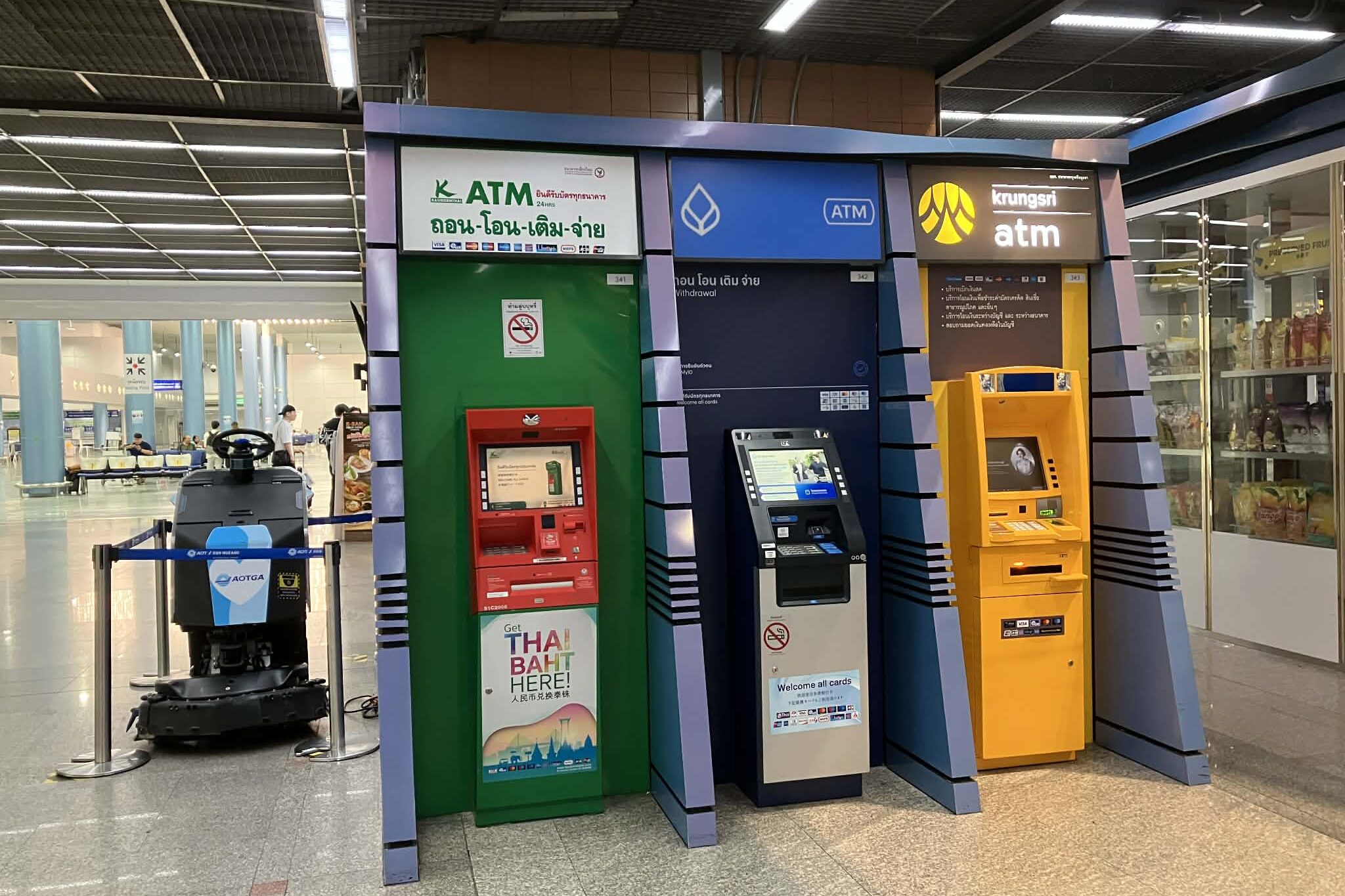
There are also ATMs on the arrivals floor, which remain usable overnight.
Starbucks
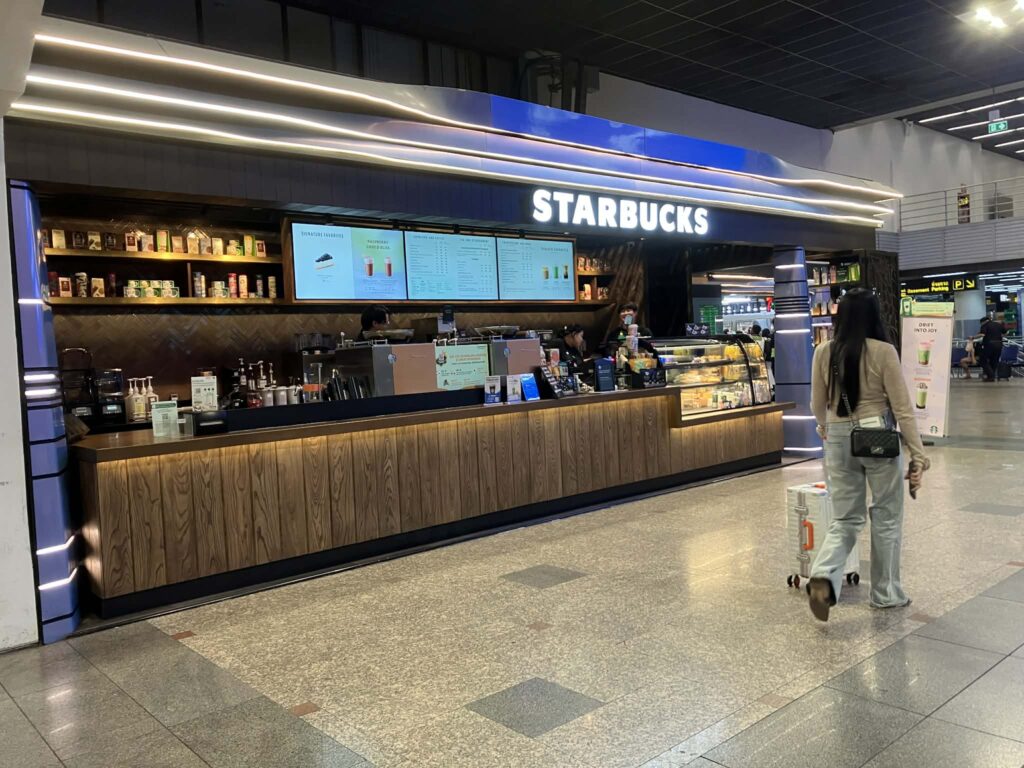
The Starbucks on the international arrivals level was already closed when I checked at around 11 PM.
Do not count on it late at night.
Magic Food Park
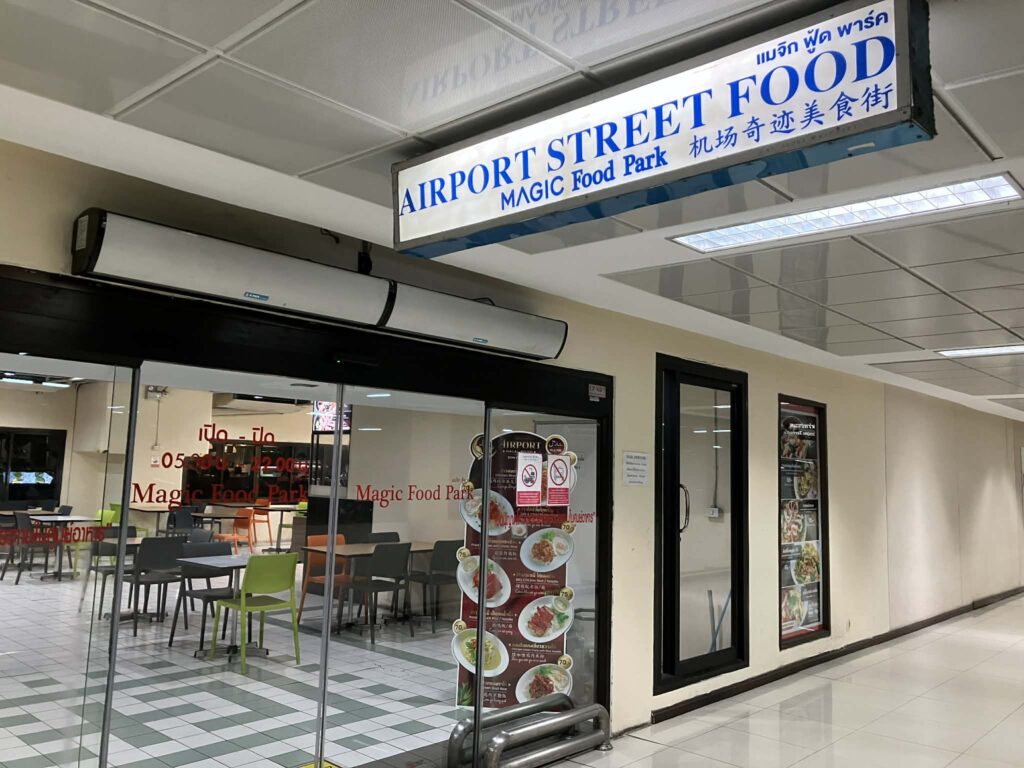
This local-price food court on the Terminal 1 side closes at 10 PM.
So it is not useful for actual overnight hours.
Magic Garden
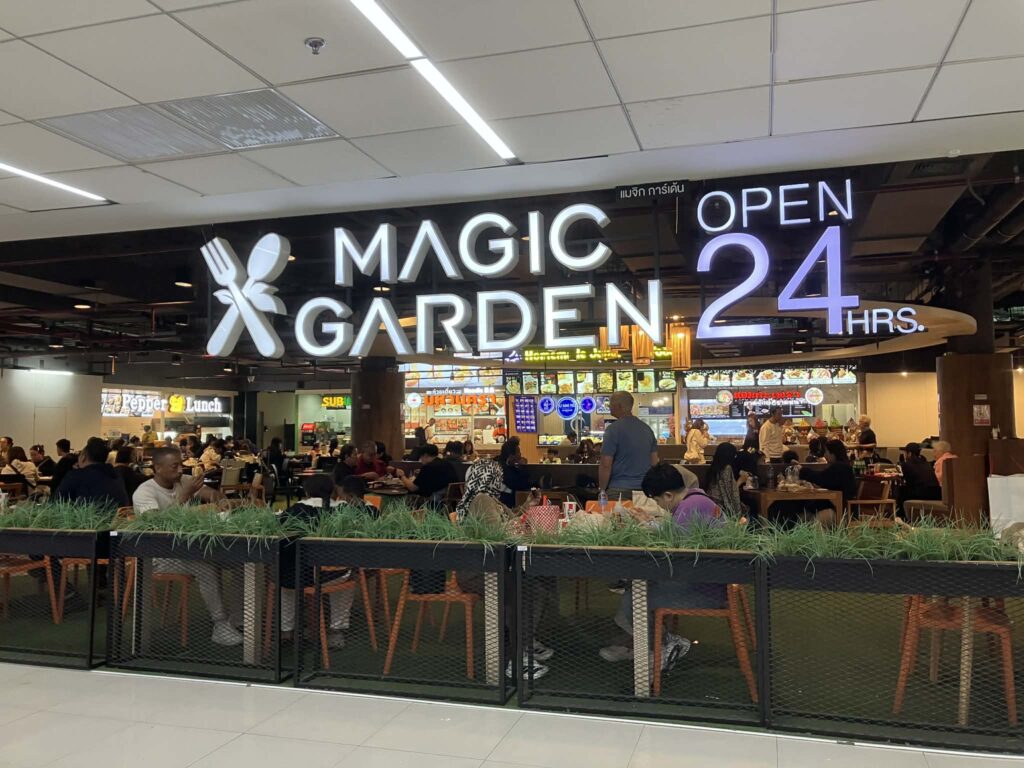
Magic Garden is marked as a 24-hour area, but that does not mean full food service all night. Most shops were closed late at night.
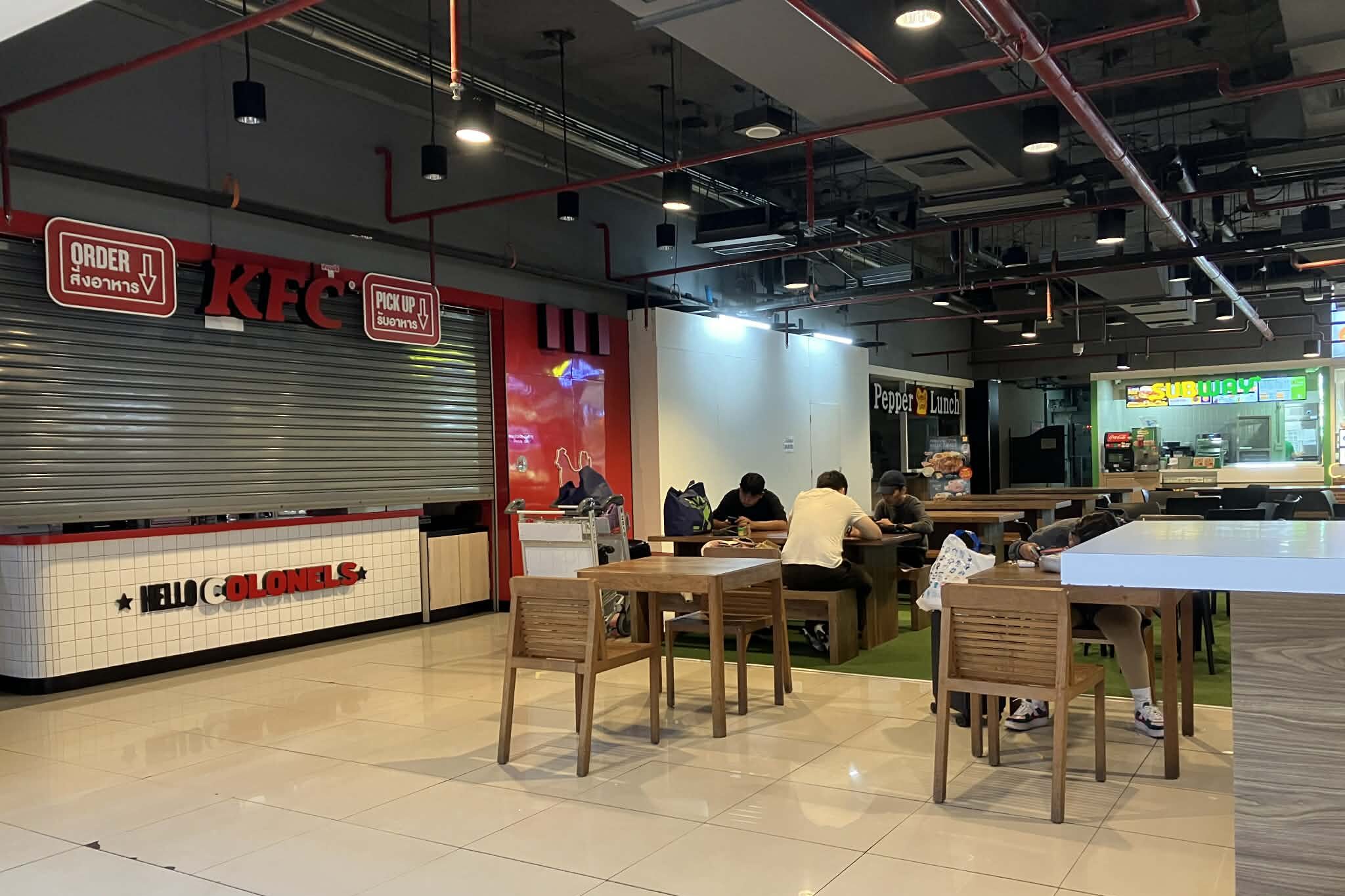
That said, tables and chairs remain available, and people were using the area simply as a place to sit and wait.
Food area opposite Magic Garden
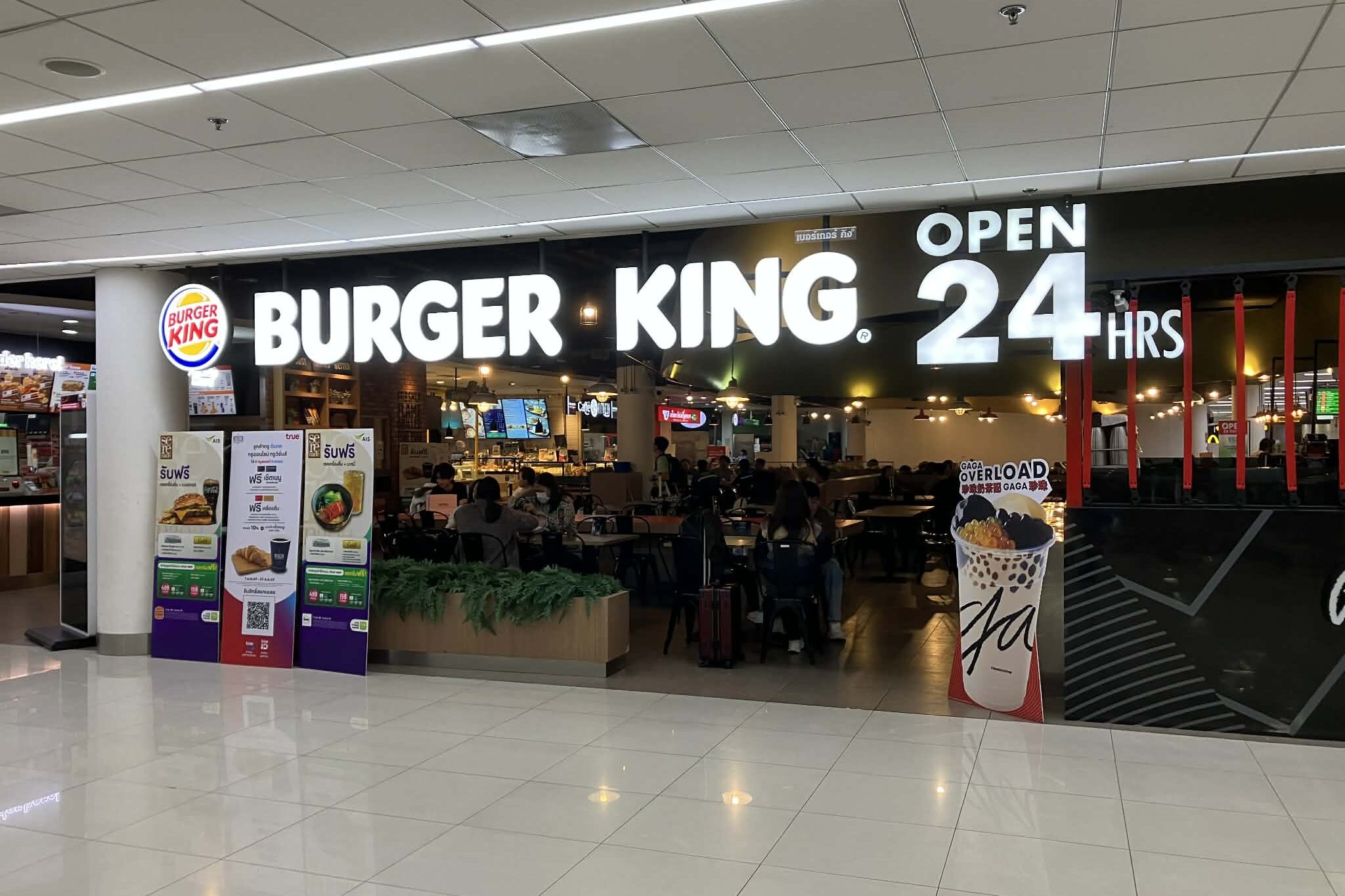
Across from Magic Garden, there are still some late-opening options, including Burger King.
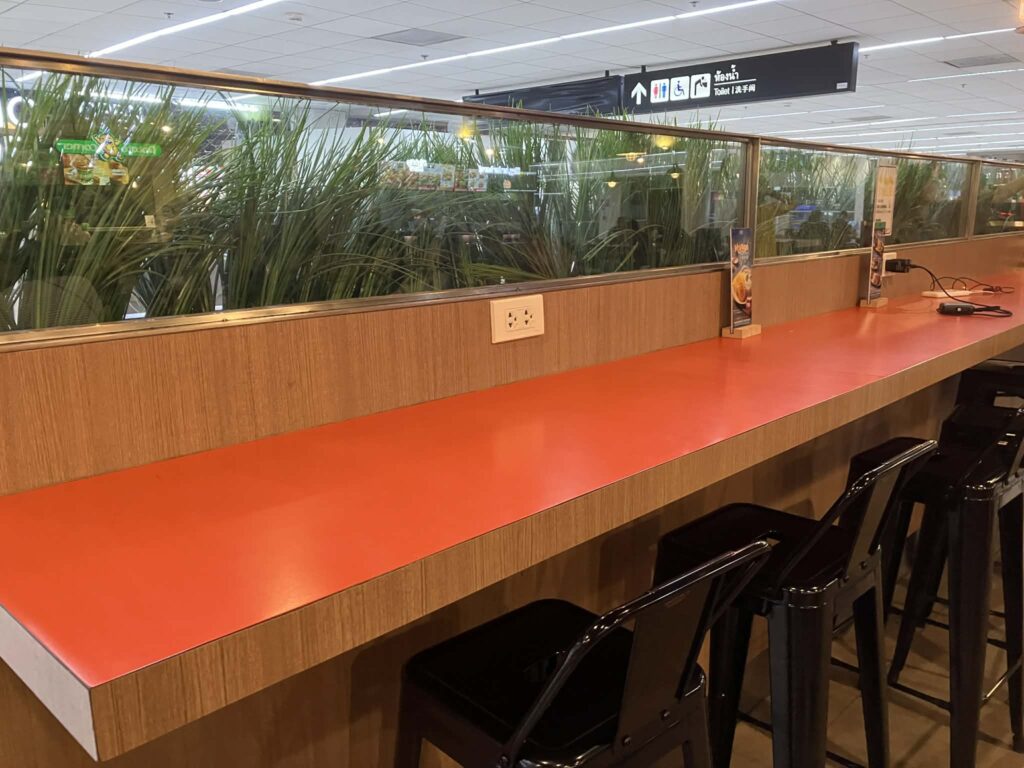
This area is actually useful not just for food, but for staying put for a while. Some seats have charging outlets, and I also saw people lying down here.
Wi-Fi and charging: good enough overnight
Wi-Fi
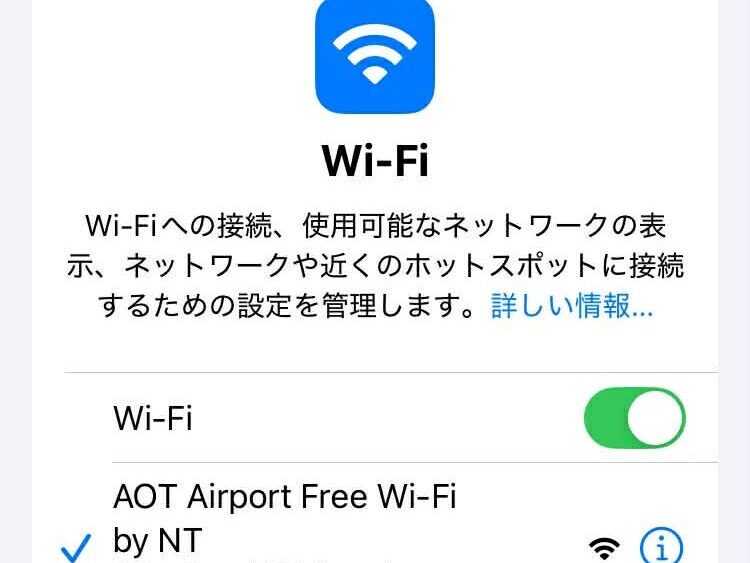
Don Mueang offers free Wi-Fi under the SSID:
AOT Airport Free Wi-Fi by NT
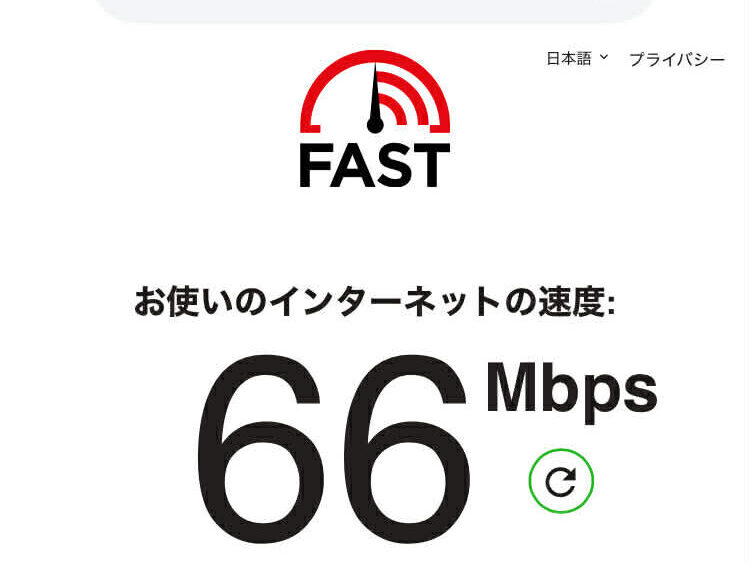
When I tested it, the speed was roughly 66 Mbps download, which is more than enough for browsing, messaging, video streaming, or even basic online work.
The official session is limited to one hour at a time, but you can simply log in again afterward. Overnight, the connection remained stable.
Charging
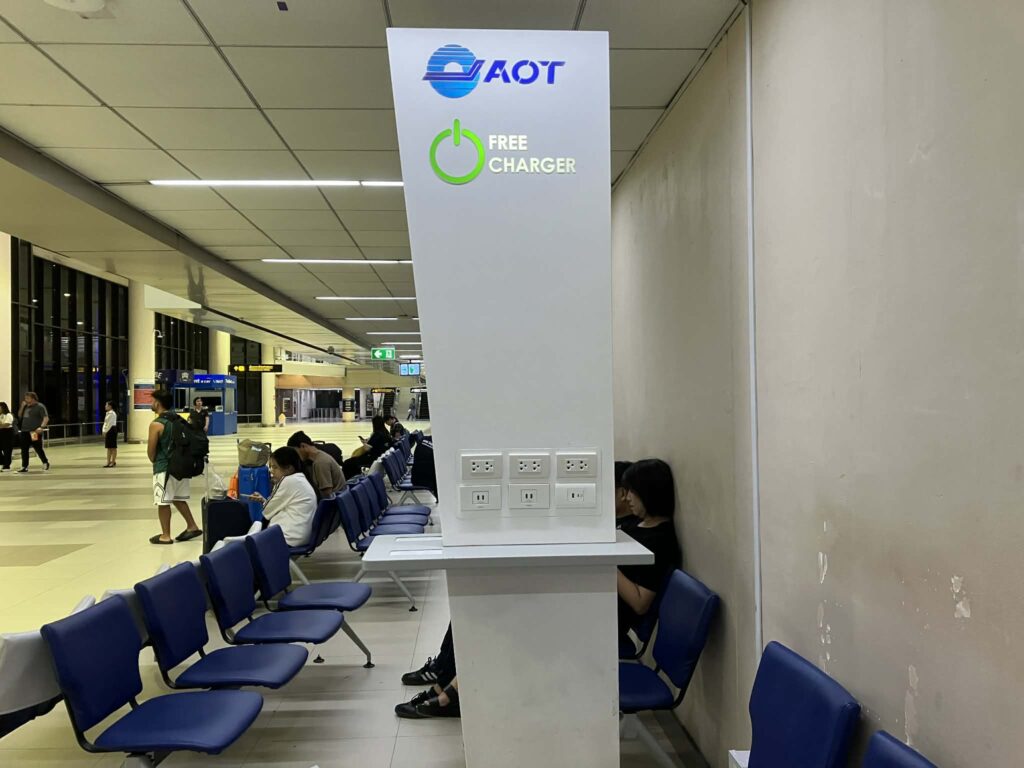
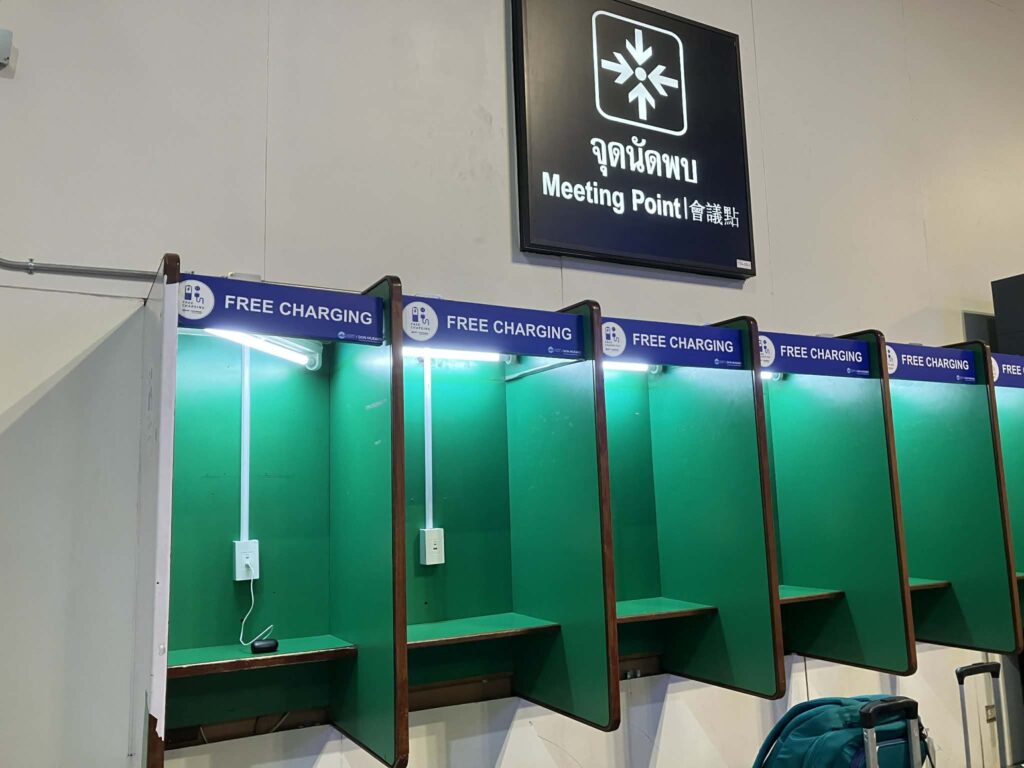
Power outlets are available, but not attached to every bench.
You will find:
- dedicated charging corners
- wall outlets
- floor outlets
- some restaurant or seating areas with sockets
Late at night, competition did not seem too severe, because travelers were spread out. Around the Magic Garden food area, finding a table with power was realistic.
That said, the key limitation is obvious:
the best sleeping benches are usually not the best charging spots.
If you plan to stay overnight, bring a power bank.
Is it safe? What about solo female travelers?
This is the part people worry about most.
My conclusion is simple: Don Mueang’s public areas did not feel unsafe overnight.
There were always people around, and the space never became deserted. I saw a normal mix of travelers:
- solo women
- backpackers
- families
- business travelers
It did not feel like a space taken over by one particular type of traveler. It still felt like a functioning airport.
Security and staff presence
What helped was the constant sense that the airport was still being managed:
- security staff were present
- cleaners became more visible after around 1 AM
- robot cleaning machines were constantly moving around
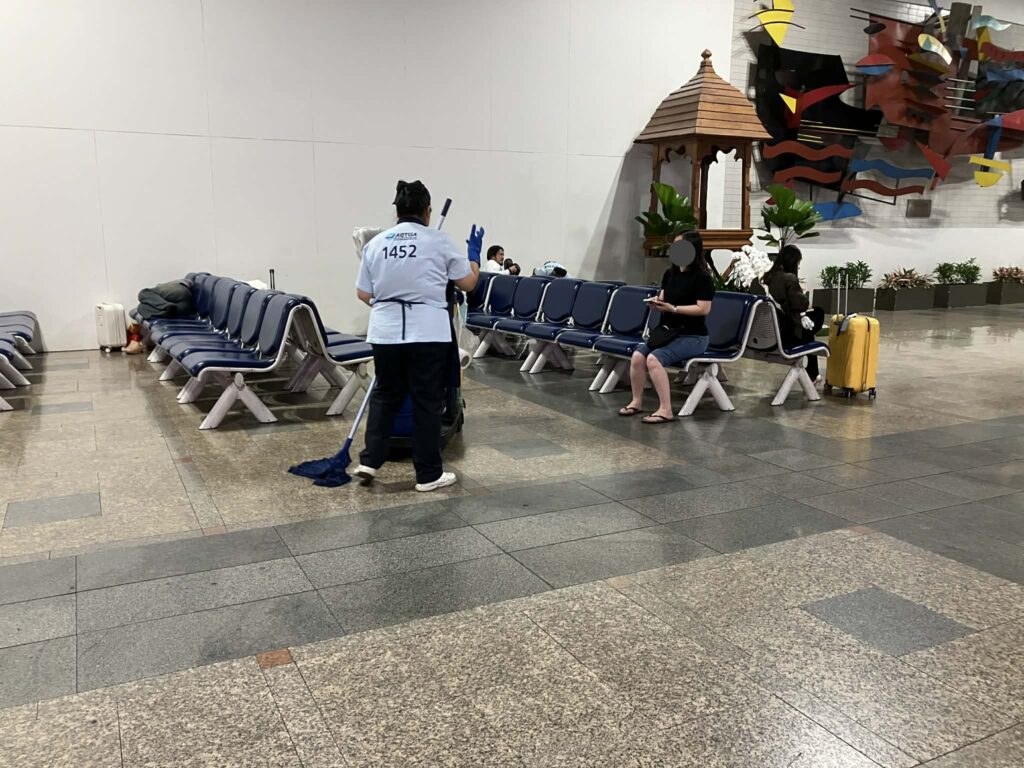
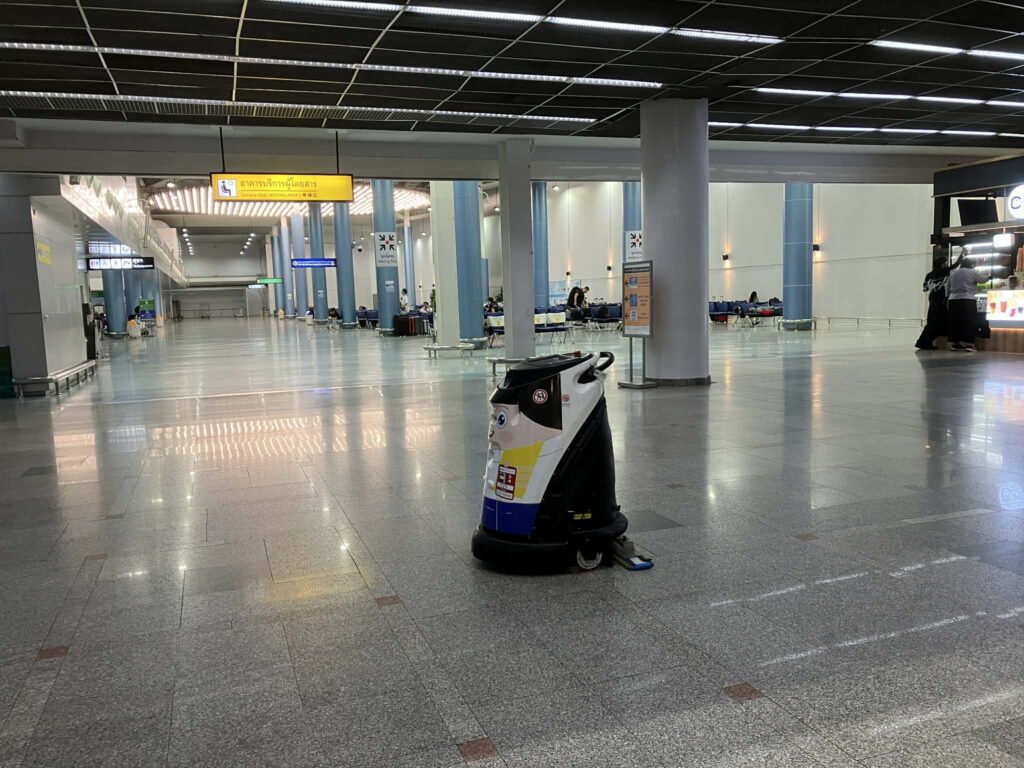
That makes a difference. The airport never felt abandoned.
How people handle luggage
Most people sleeping overnight kept their luggage very close, usually touching it with their legs or arms. I did not see people leaving valuables unattended.
That is the correct approach here, and really the correct approach at any airport.
Common sense still applies
Even if the airport feels safe, do not be careless.
- keep valuables on your body
- lock your bag if possible
- do not leave your phone out while sleeping
So yes, for a public airport space, Don Mueang felt workable and reasonably safe.
Not luxury, not private, but not a place that felt risky by default.
Paid option: Sleep Box by Miracle
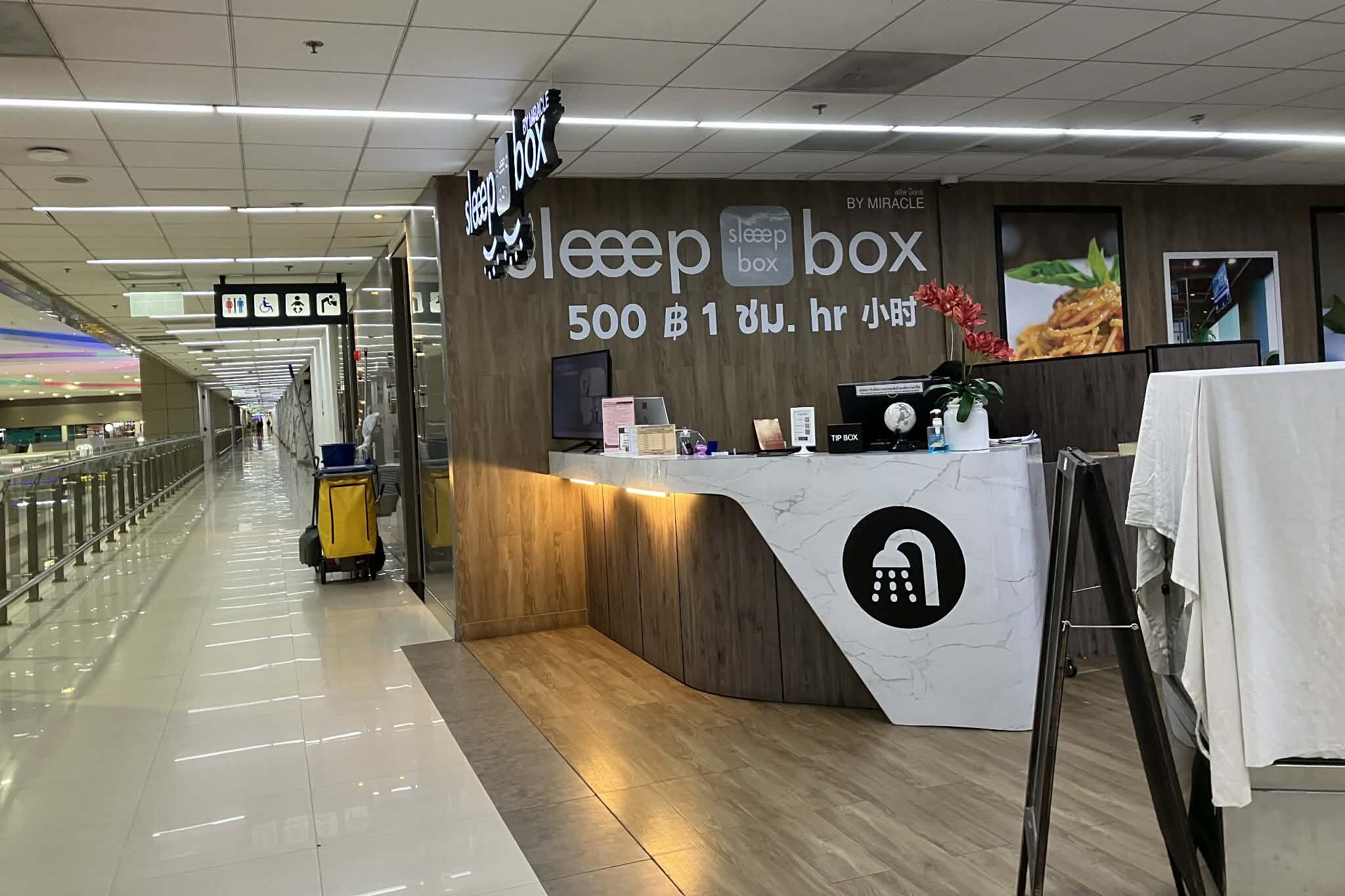
If you want a real private place to lie down, there is a paid option.
On the 4th floor of the domestic terminal, you will find Sleep Box by Miracle. This is basically a compact private rest facility inside the airport.
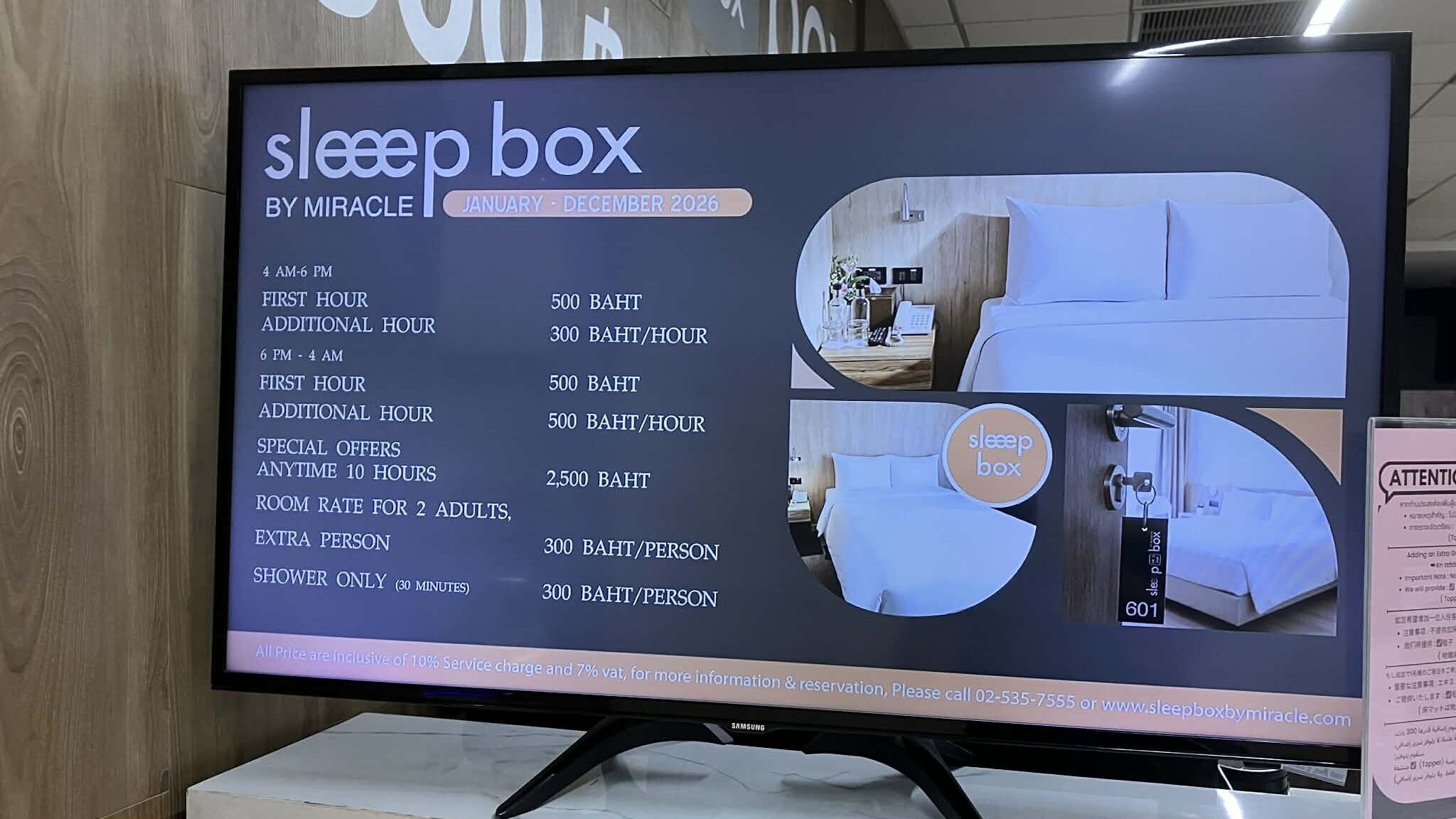
It is not cheap.
Pricing is hourly, and the nighttime rate is higher than the daytime rate:
- Daytime (4:00 AM–6:00 PM): extra hour 300 THB
- Nighttime (6:00 PM–4:00 AM): extra hour 500 THB
So if you stay 4 hours at night, you are already paying around 2,000 THB.
A 10-hour package is 2,500 THB.
At that point, compared with a budget hotel in Bangkok, it is clearly a convenience product rather than a cheap one.
Shower-only option
The more interesting part is that you can also use just the shower:
- 300 THB for 30 minutes
That matters, because I did not find a normal public shower in the landside public area. The lounges available through Priority Pass also did not solve this, since I did not confirm shower access there.
So the most practical use case is:
sleep on a bench overnight, then pay for a shower in the morning
That is a much more realistic value proposition than paying for several hours of Sleep Box unless you really need proper sleep.
Is it worth it?
Simple answer:
- Want real rest and privacy → Sleep Box
- Only need to survive a few hours → bench sleep is enough
Sleep Box is basically comfort for money.
Left luggage services exist, but are not essential
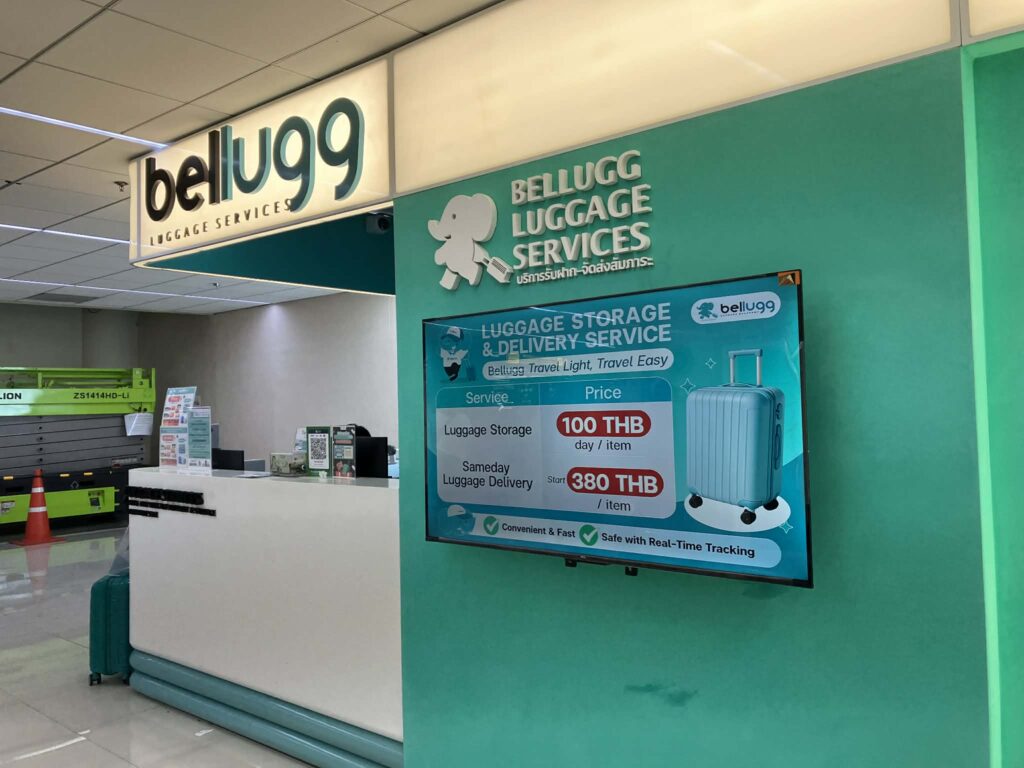
On the 1st floor of the terminal connector area, there are luggage storage counters including Airportels and Bellugg Luggage Services.
Rates start from around 100 THB per day, depending on size and weight. Both also offer city delivery.
For overnight sleeping, though, this is optional rather than necessary.
Most travelers I saw simply kept their suitcase right next to them while resting. For a short overnight stay, that is usually enough.
Storage becomes more useful if:
- you have multiple large suitcases
- you want to sleep without worrying about baggage position
- you are combining the overnight stay with city movement before or after
So yes, it is available, but not a must.
Lounges and waiting airside
If you are departing from Don Mueang, another strategy is to move airside after check-in and wait there instead.
With Priority Pass, the options include:
- Coral Lounge
- Miracle Lounge (two locations)
These are after security.
The problem is time limit:
- Miracle Lounge: usually 2 hours
- Coral Lounge: usually 3 hours
So they are not built for spending the whole night.
The realistic use is:
sleep a bit landside → check in → go airside → use lounge for 2–3 hours before boarding
That works well. But it is not a replacement for the entire overnight stay. If you want a more comfortable option during that time, consider using a lounge such as the Coral Executive Lounge at Don Mueang Airport.
If you skip the lounge, waiting airside is still possible. There are plenty of seats, but once early flights begin stacking up, the area becomes more crowded and less restful.
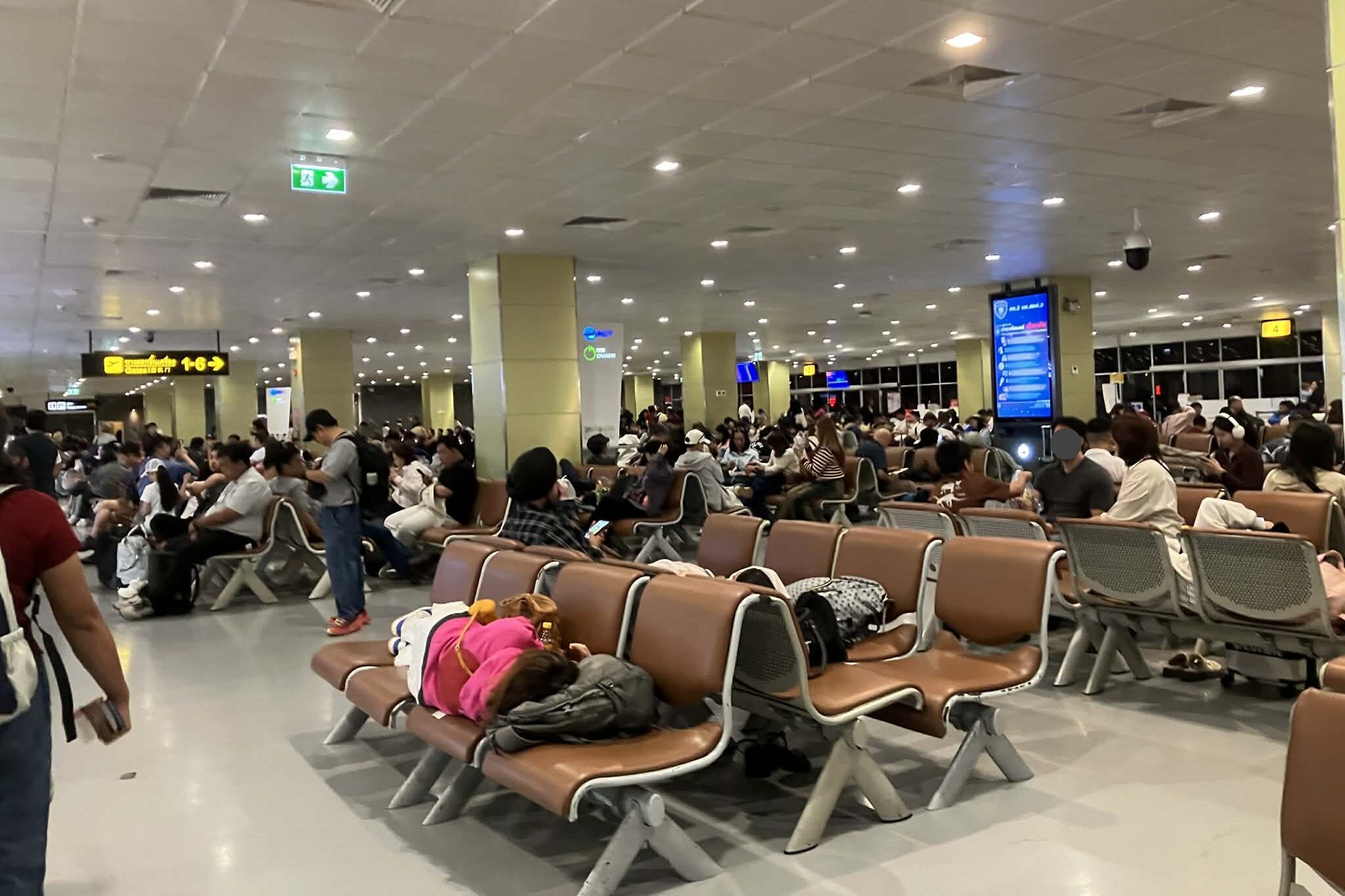
Airside is fine for waiting.
Landside is where the actual overnight sleeping happens.
Biggest danger of airport sleeping: missing check-in
This is the one point that matters most.
Yes, overnight stays at Don Mueang are possible.
Yes, you can rest.
But do not get careless about check-in deadlines, especially with low-cost carriers.
LCCs are strict. Even a few minutes late can mean zero flexibility.
I learned that the hard way.
On a previous trip, I had an early-morning AirAsia flight departing around 6 AM. I slept in the terminal connector area, woke up, and realized I was about five minutes past the check-in cutoff.
Even though I was physically very close to the check-in counters, it did not matter. I had to buy a new ticket on the spot.
That is the real risk of airport sleeping.
Not safety.
Not lack of benches.
Time management.
If you stay overnight at Don Mueang:
- check your check-in deadline carefully
- set multiple alarms
- check in early if possible
- if kiosk check-in or early bag drop is available, move airside as soon as you can
The airport gives you proximity.
It does not protect you from oversleeping.
Best place to sleep at Don Mueang Airport
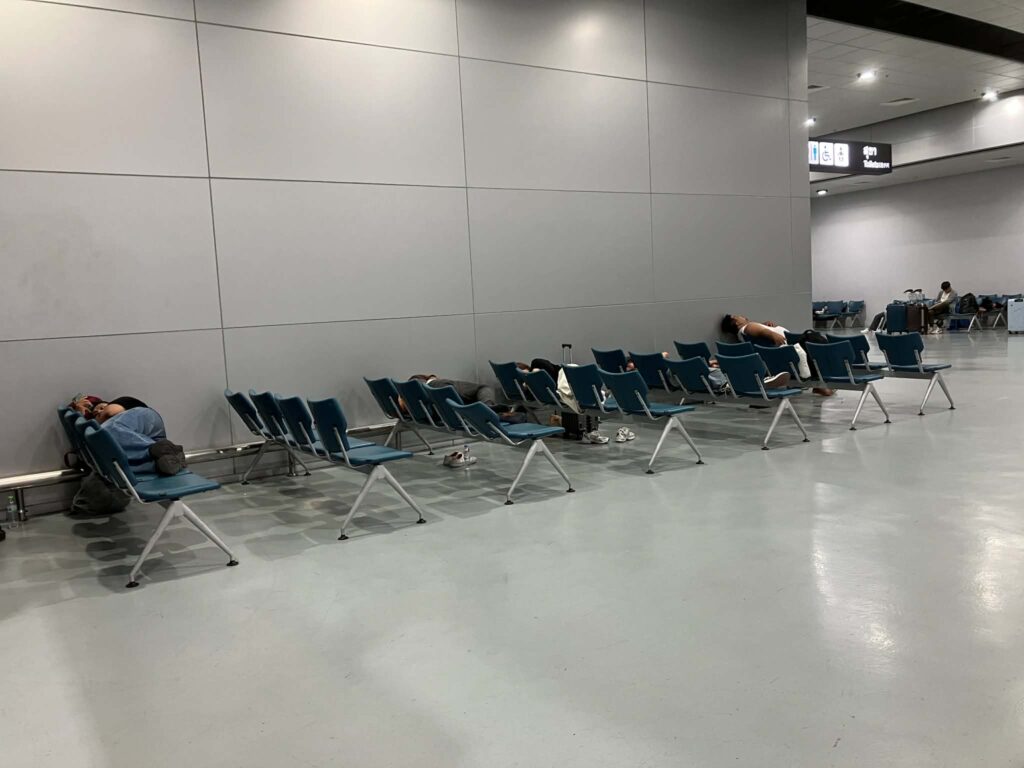
After walking through the airport late at night, my own conclusion is this:
the best area for actual sleep is the wall-side bench area on the international arrivals level (Terminal 1, 1st floor).
Why?
- fewer people than the departure floor
- less chaotic than airside
- still enough activity to feel safe
- practical bench layout
Cleaning still happens, but foot traffic is manageable.
Airside is more crowded and comes with more announcements, so it is not ideal for long rest. The domestic departure floor can be quieter, but if you are flying international, it is slightly less convenient.
If you want comfort, pay for a lounge or Sleep Box.
If your goal is simply to survive the night for a few hours, the arrivals level is the most realistic choice.
Who should and should not sleep at Don Mueang?
Good fit for airport sleeping
Don Mueang overnight stays make sense for travelers who:
- arrive late or fly early and want to save both time and hotel cost
- can rest in a bright public space with some movement
- do not need perfect sleep, only enough rest to get through the flight
There are benches, convenience stores, Wi-Fi, and workable quiet zones. If your goal is not “a good night’s sleep” but rather “enough rest before the next flight,” Don Mueang can do the job.
Not a good fit
It is a poor fit if you:
- care more about sleep quality than cost
- have an important next day and need to be fully rested
- cannot sleep in bright or cold public spaces
- get neck or back pain easily from bench sleeping
An airport is still an airport. The lights stay on, people start moving again before dawn, and sleep quality is always worse than in a hotel.
So yes, airport sleeping works here.
But that does not mean it is comfortable for everyone.
If you also want to compare Bangkok’s other airport, see the Suvarnabhumi Airport overnight sleeping guide.
Final verdict: yes, Don Mueang airport sleeping works
The answer is clear.
Yes, you can sleep overnight at Don Mueang Airport.
If you choose your area well, you can lie down, rest for a few hours, use free Wi-Fi, buy snacks at convenience stores, and wait safely until your flight.
There are also quieter corners such as the observation deck and the terminal connector, plus paid comfort upgrades like Sleep Box and shower access.
The main thing to respect is not comfort. It is time.
If you miss an LCC cutoff, the cheap overnight stay becomes expensive very quickly.
So as long as you understand the trade-off, Don Mueang is a workable airport for spending the night.